Careers
Nurse Educator Careers For DNP-Prepared Nurses
- 77,960Employed NationallyBLS OEWS, May 2025
- 1,588Faculty Vacancies, 2025AACN
- 80.9%Vacancies Wanting A DoctorateAACN
Reviewed
On this page
Key Takeaways
- 1
Openings are plentiful: 1,588 of them. Across 863 schools in 2025, a 7.2% vacancy rate (AACN).
- 2
The pay is $17,000 below the bedside. Faculty median $80,250 against $97,550 for registered nurses. Both facts are true at once.
- 3
A master’s is enough to teach. a master’s or doctoral degree in nursing, plus graduate coursework in education or two years teaching. The credential this profession issues does not ask for a doctorate, so the degree is a choice about where you want to compete rather than a condition of entry.
- 4
The PhD and the DNP are not interchangeable here. A research university tenure line usually expects the research doctorate. Teaching-focused and clinical-track appointments suit the DNP. Settle this before choosing a program.
What Does A Nurse Educator Do?
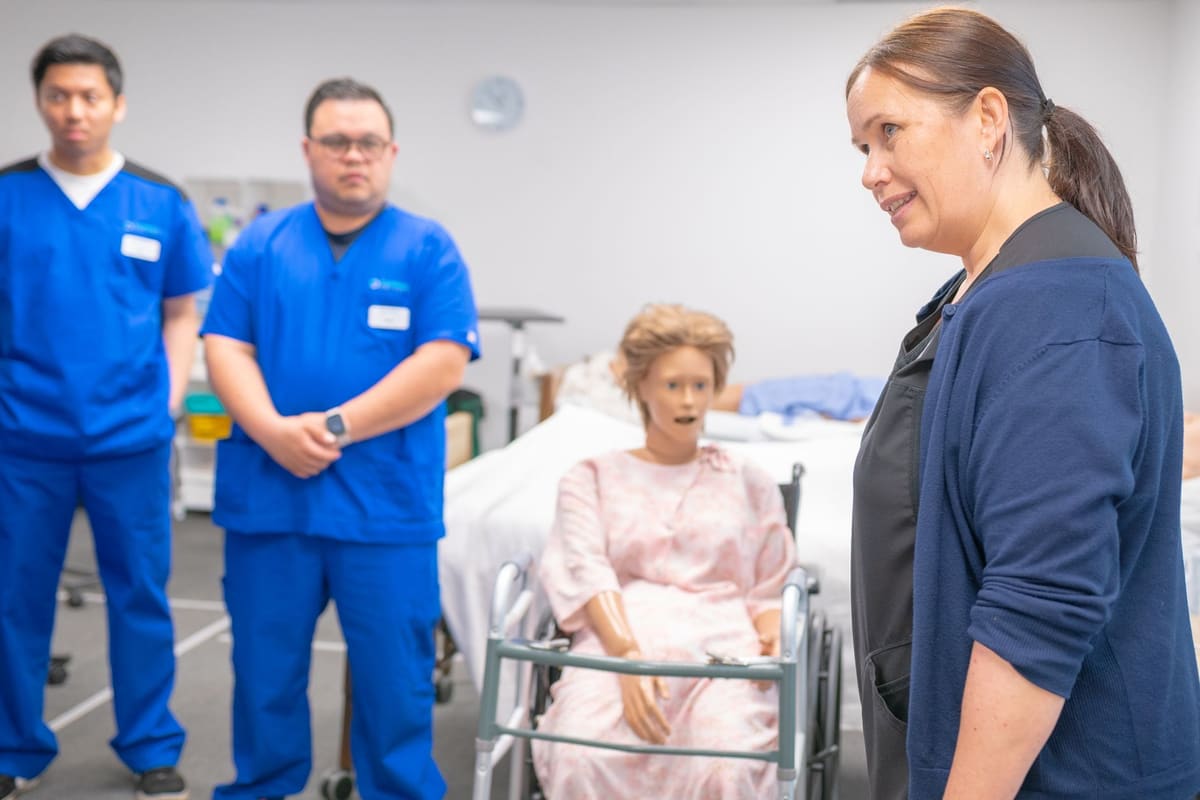
Teaching is the visible part: lectures, seminars, and running students through scenarios in a simulation lab. It is not the largest part.
Clinical supervision usually is. Nursing programs place students in hospitals and clinics, and faculty go with them, which means several days a week on a unit managing a group of students on someone else's schedule and someone else's patients. People who imagine an academic post as a way out of shift work are often surprised by how much time it puts back on a ward.
Then there is the work that keeps a program running. Curriculum design and revision, writing and marking assessments, advising students, and the committee load that accreditation requires. Accreditation is a real driver of the job: programs are reviewed against standards, and faculty are the people who produce the evidence for it.
In a tenure-track post at a research university, add scholarship and grant funding on top, and those are not optional extras. They are what tenure is decided on.
Where Nurse Educators Work
The federal occupation counts postsecondary teaching, which spans community college associate-degree programs, universities running BSN through doctoral degrees, and hospital-based schools. Those are quite different jobs.
Community college programs are teaching-focused, with heavy clinical supervision loads and no research expectation, and they are where a great deal of US nursing education actually happens. Universities split appointments between tenure-track lines with a research expectation and clinical or teaching tracks without one. The title on the post tells you which, and it matters more than the institution's name.
Outside academia there is a second kind of nurse educator this occupation does not count: hospital-based staff development and clinical education roles, which sit inside a health system rather than a school. They are paid on the health system's scale rather than an academic one, and they do not appear in the wage figures on this site because the survey counts them elsewhere.
How To Become A Nurse Educator
Hold an RN license and clinical experience. You are going to teach practice, and students spot an instructor who has not done the work recently. There is no fixed requirement, but the credibility question is real.
Earn a graduate degree in nursing. The National League for Nursing asks for a master’s or doctoral degree in nursing for its educator credential. A master's qualifies you to teach.
Add education coursework, or teaching experience. The credential accepts graduate coursework in curriculum, instructional design, assessment or adult learning, a nursing education emphasis within a graduate degree, a post-master's certificate, or two years teaching in an academic nursing program. Knowing your specialty is not the same as knowing how to teach it, which is what that requirement is getting at.
Start part time if you can. Adjunct and clinical instructor posts are the standard way into this field and they are widely available. It is the cheapest possible test of whether you like the work, and it happens before you commit to a doctorate.
Take the doctorate for the appointments that need it. Which one is the next section, and it is the decision worth the most thought.
DNP Or PhD For A Faculty Career?
This is the one place on this site where getting the choice wrong costs three years, so it is worth more than a paragraph.
A PhD is a research doctorate. It trains you to generate knowledge, and a tenure-track line at a research university is built around exactly that: publishing, winning grants, supervising doctoral students. If that is the appointment you want, the PhD is usually the expected credential and a DNP will be a harder sell regardless of how strong you are.
A DNP is a practice doctorate. It trains you to apply evidence and lead systems change, and it keeps you close to current practice, which is precisely what clinical teaching needs. For teaching-focused institutions, clinical-track appointments, community colleges and program leadership roles it fits well and is frequently preferred.
The test that settles it faster than any general comparison: open the faculty directory of three or four schools you would actually want to work at, find the posts you would want, and see which doctorate the people holding them have. That tells you what the hiring committee expects better than anything written in the abstract, including this page.
If the DNP is the right answer, note that the 1,000-hour practice expectation still applies to a degree taken for a faculty career. It counts from the baccalaureate rather than per program, so hours from a master's can count toward it, and how many a program recognizes is worth settling before you enroll.
What Nurse Educators Earn
$80,250 at the median across 77,960 postsecondary nursing instructors (BLS OEWS, May 2025). Registered nurses have a median of $97,550, so teaching is $17,000 lower. Against nurse practitioners the gap is wider still. BLS classifies by occupation, not by credential: there is no DNP wage series, and every figure here covers everyone in the occupation regardless of which degree they hold.
The two caveats that genuinely bear on that comparison, contract length and the mix of part-time appointments in the count, are set out on the nurse educator salary page along with the full percentile spread.
The Career Path, Stage By Stage
Nobody moves through these on a schedule, and the years attached to them in job adverts are a convention rather than a rule. What is reliable is the order.
-
Expert Clinical Nurse
Every route into nursing education starts with being good at the thing you will teach. Programs hire on clinical credibility, and students detect a faculty member who has not done the work recently. Precepting and unit-based education is where most people find out they like teaching.
-
Clinical Instructor Or Adjunct
The usual door in, and it is often part-time and poorly paid. You take a clinical group one or two days a week alongside a clinical post. It is the least glamorous stage and the one that tells you honestly whether the classroom is for you.
-
Full-Time Faculty, Non-Tenure Track
A teaching-focused appointment, typically instructor or clinical assistant professor. This is where most nurse educators spend their careers and where the pay gap against clinical practice becomes concrete rather than theoretical.
-
Tenure-Track Or Program-Track Faculty
The two paths diverge sharply here. A tenure track expects scholarship and usually a PhD. A practice-focused track expects program leadership and is where the DNP sits comfortably. Choosing between them is a bigger decision than choosing an institution.
-
Program Director, Associate Dean, Dean
Administration, and the point at which the pay finally becomes competitive with senior clinical practice. It is also the point at which you largely stop teaching, which is an irony most people in the role will mention if you ask.
The Trade You Are Actually Making
You give up money. Not a little, and not temporarily. The people who are happy in this work are generally clear-eyed that they took a pay cut and think it bought something worth having.
What it buys is a different rhythm and a different kind of difficulty. Academic calendars have breaks in them, the schedule is more predictable than shift work even with clinical supervision in it, and the intellectual work is genuinely different from clinical practice. Some people find the shift from patients to students energizing and some find it a loss. Adjunct teaching is how you find out which you are without gambling three years on it.
The demand is real and it is not going to fix the pay. High vacancy rates alongside low salaries describe a sector where the funding to raise wages is not there, not a market about to correct. Plan on the number in front of you.
The upside worth naming is the ceiling. Program director, associate dean and dean posts are paid substantially better than a teaching line, and they are reached through academic appointments rather than clinical ones. If administration is where you are heading, the faculty route is the road there and the early years are the toll.
A Day In The Job
A teaching day is less classroom time than people expect and much more preparation. Two hours of lecture takes considerably longer than two hours to build if it is any good, and the good faculty are the ones who rebuild rather than reuse, because the evidence and the guidelines move.
Clinical days are a different job entirely. You take a group of students onto a unit and are responsible for every patient they touch, which means eight students, eight assignments, and a level of vigilance that experienced faculty describe as more tiring than staff nursing ever was.
Then there is the part nobody applies for. Grading, which is relentless and which students care about far more than you expect. Committee work, accreditation self-studies, curriculum mapping and the documentation that keeps a program approved. In a semester this can be more of your week than teaching is.
The compensation is the office hour where a student who was failing works out what they were missing, and the graduation where somebody you taught walks across a stage. Everyone in nursing education tells a version of that story, and it is the honest reason people accept the pay.
Pros And Cons, The Honest Version
What Is Good About It
- You shape a whole cohort rather than a caseload, and the effect compounds through every patient your students go on to treat.
- Academic schedules are unusually humane. Summers, breaks and no night rotation is a real change after a decade of shift work.
- The work is intellectually alive. Staying current is part of the job rather than something squeezed around it.
- Demand is genuine and documented. Faculty vacancies are a recognized constraint on how many nurses the country can educate.
- It is one of the few nursing roles where you can keep a clinical post part-time and do both.
What Is Hard About It
- The pay is the problem and it is structural. Nursing instructors report the lowest median of the six nursing occupations BLS publishes.
- Many appointments are nine-month contracts, so an advertised salary may cover three quarters of a year rather than all of it.
- The route in is often part-time adjunct work at rates well below clinical practice, which makes the transition slow.
- Grading, committees and accreditation paperwork take more of the week than most people anticipate.
- The tenure track expects scholarship, and if you took a DNP rather than a PhD that path is harder and sometimes closed.
Is This The Right Job For You?
Four questions worth answering before you commit tuition to this. They are the ones people say afterwards that they wish somebody had asked.
-
Have You Looked At The Pay Honestly?
This is the question the whole career turns on. Nursing faculty is the lowest-paid destination on this site, and if the contract is for nine months the gap against clinical practice is wider than the headline figures suggest. People who go in knowing this are generally content. People who discover it in their second year are not.
-
Do You Enjoy The Students Who Are Struggling?
Teaching the capable ones is straightforward and it is not the job. The job is the student who has failed a course, who is frightened, and who may or may not be safe to pass. If that prospect is interesting rather than draining, this is a career that will suit you.
-
Are You Willing To Do The Invisible Work?
Curriculum mapping, accreditation self-studies, committee minutes and grading are most of the calendar in some semesters. Nobody applies for them and every program depends on them. Ask a working faculty member what proportion of their week they take.
-
DNP Or PhD, And Have You Decided Why?
This is the choice that determines which faculty ladder is open to you, and it should be made deliberately rather than by whichever program admitted you. The practice doctorate fits teaching and program leadership. The research doctorate fits the tenure track. Working that out first saves years.
Frequently Asked Questions
What does a nurse educator do?
In an academic post: teaching in classrooms and simulation labs, supervising students in clinical placements, designing and revising curriculum, assessing students, advising them, and serving on the committees that keep a program accredited. Clinical placement supervision is the part that surprises people, because it puts you back in a hospital several days a week on someone else's schedule.
Do you need a doctorate to teach nursing?
Not to teach. The National League for Nursing requires a master’s or doctoral degree in nursing for its educator credential, along with graduate coursework in education or two years teaching in an academic nursing program. What the doctorate changes is which posts are open: AACN found 80.9% of full-time faculty vacancies in 2025 required or preferred one, and tenure-track appointments almost always do.
Is a DNP or a PhD better for a nursing faculty career?
It depends on the appointment you want. A tenure-track line at a research university generally expects a PhD, because the job includes producing research and winning funding. Teaching-focused institutions, clinical-track appointments and community college programs suit the DNP well, and a DNP brings current practice expertise that clinical teaching genuinely needs. Look at the faculty listings of schools you would want to work at and see which doctorate the people in the posts you want actually hold.
Can you teach nursing part time while still practicing?
Yes, and it is one of the most common arrangements in the field. Clinical instructors and adjunct faculty frequently keep a clinical post and teach alongside it, which is how many people try teaching before committing to it. It also means the occupation-wide wage figures include a lot of part-time appointments, so a full-time salary is not what the median describes.
Is there a nursing faculty shortage?
AACN reported 1,588 full-time faculty vacancies across 863 nursing schools in 2025, a vacancy rate of 7.2%, and 92,672 qualified applications turned away from baccalaureate and graduate programs. That is the accreditor's own survey of its member schools rather than a federal statistic, and it should be quoted that way.
What is the CNE credential?
The Certified Nurse Educator credential is issued by the National League for Nursing. It asks for a current RN license, a graduate degree in nursing, and either graduate coursework in education, a nursing education emphasis in a graduate degree, a post-master's certificate in nursing education, or two years teaching in an academic nursing program. It is voluntary rather than required to teach.
Sources
- 1 National League for Nursing, CNE Eligibility Eligibility for the educator credential, including the degree it requires.
- 2 AACN, Nursing Faculty Shortage fact sheet Vacancy count, vacancy rate, doctoral share and applications turned away, 2025.
- 3 BLS OEWS, May 2025, Nursing Instructors and Teachers, Postsecondary (25-1072) Median $80,250 across 77,960 employed.
- 4 BLS OEWS, May 2025, Registered nurses (29-1141) Median $97,550. The comparison that matters here.
- 5 AACN, Frequently Asked Questions: DNP Programs & CCNE Accreditation, Q9 The 1,000-hour practice expectation for DNP programs.
Every federal figure on this site is read from the administering agency’s own page, never from a secondary aggregator, and the reading date is recorded beside it.